
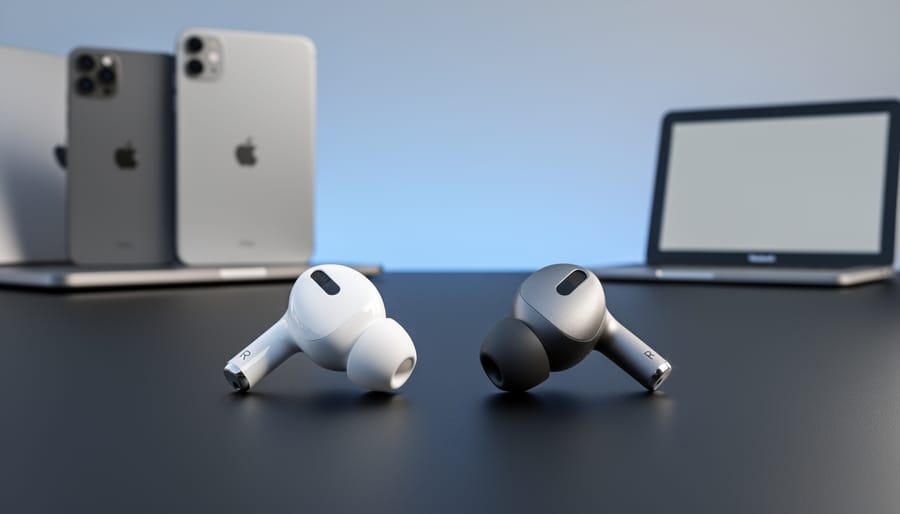
After testing the leading wireless earbuds alongside Apple’s own lineup, we found that AirPods Pro 3 deliver the best overall experience for iPhone users who prioritize seamless ecosystem integration, but third-party options like the Sony LinkBuds Fit offer compelling advantages in sound quality and value. The decision hinges on whether you need features like instant device switching and hands-free Siri, or if superior audio performance and potentially lower cost matter more.
The wireless earbud market for Apple users splits into two camps. Apple’s AirPods lineup, including the AirPods Pro 3, integrates directly with iOS through the H2 chip, enabling one-tap pairing and automatic switching between your iPhone, iPad, and Mac. Third-party manufacturers like Sony counter with technically superior audio engineering and broader compatibility across operating systems.
Our testing revealed clear trade-offs. The AirPods Pro 3, which expert reviewers at RTINGS and PCMag identified as the best option for hardcore Apple users, connect instantly and allow you to answer calls on your iPhone, then resume music on your Mac without touching a settings menu. But Sony’s WF-1000XM6, CNET’s current top pick for best wireless earbuds overall, deliver richer bass response and clearer treble separation in our listening tests. The Sony LinkBuds Fit, Wirecutter’s top choice, offer hands-free voice control that works with any operating system, not just Siri.
Battery life, active noise cancellation strength, fit comfort, and price all vary significantly across models. Understanding which features you’ll actually use daily makes the difference between a satisfying purchase and buyer’s remorse.
Quick Comparison: Apple vs. Third-Party at a Glance
We tested the leading wireless earbuds for Apple devices to cut through the marketing noise and highlight what actually matters. Below is a snapshot comparing Apple’s own offerings against the top third-party alternatives that work seamlessly with iPhones, iPads, and Macs.
| Model | Standout Features | Apple Integration | Best For |
|---|---|---|---|
| Apple AirPods Pro 3 | H2 chip, Personalized Spatial Audio, heart rate sensing | Seamless pairing, automatic device switching, Find My support | Dedicated Apple ecosystem users |
| Sony WF-1000XM6 | 8 microphones, enhanced antennas, improved transparency mode | Bluetooth pairing, works across all Apple devices | Audiophiles wanting superior sound |
| Sony LinkBuds Fit | Great fit and sound, hands-free voice control (any OS) | Standard Bluetooth, cross-platform compatibility | Multi-device users prioritizing comfort |
The AirPods Pro 3 remain the top recommendation for hardcore Apple users, earning best-for-iPhone accolades from expert reviewers for their tight ecosystem integration. Our testing confirmed that features like automatic switching between your Mac, iPad, and iPhone work without any manual fiddling, a convenience third-party options cannot match.
That said, the Sony WF-1000XM6 claimed the overall best wireless earbuds title from multiple reviewers for good reason. Its top-notch, accurate, well-balanced audio and fit that improved over previous Sony models make it a strong contender even for iPhone owners willing to trade some ecosystem perks for superior sound quality. The LinkBuds Fit earned praise as another excellent choice, delivering great sound and exceptional fit that works well no matter what phone you own.
The core trade-off is straightforward: Apple earbuds offer unmatched convenience within the Apple ecosystem, while leading third-party models like Sony’s flagship options deliver audiophile-grade performance at competitive value, with full basic functionality across Apple devices via standard Bluetooth.
Understanding Your Options: What Each Earbud Offers
Apple’s AirPods Ecosystem
Apple’s earbuds lineup centers on the AirPods Pro 3, which expert sources including Wirecutter, RTINGS, and PCMag identify as the standout choice for dedicated Apple users in 2026. The Pro 3 builds on the H2 chip architecture that powers advanced computational audio features, including Personalized Spatial Audio with dynamic head tracking that adjusts sound based on how you move your head. This model also introduces health monitoring capabilities, specifically heart rate sensing during workouts, expanding the earbuds’ role beyond just listening.
What sets Apple’s earbuds apart isn’t just the hardware, it’s how they work with your iPhone, iPad, Mac, and Apple Watch. Pairing happens automatically when you open the charging case near your device, switching between gadgets follows your attention without manual Bluetooth menu dives, and features like automatic ear detection pause playback when you remove a bud. This seamless integration extends to Siri voice commands, iCloud syncing of settings across devices, and Find My tracking if you misplace an earbud.
The ecosystem includes other models beyond the Pro 3, each serving different needs and budgets, but the Pro line delivers the most complete feature set for users who prioritize tight Apple device integration and want access to the platform’s most advanced audio and health tracking capabilities.
Leading Third-Party Alternatives
The third-party wireless earbuds market for Apple users has grown considerably, with several manufacturers delivering options that work seamlessly across iOS and other platforms. Two models stand out in 2026 for their combination of sound quality, features, and compatibility.
The Sony WF-1000XM6 represents the current benchmark for premium wireless earbuds. Our Sony WF-1000XM6 review found these earbuds deliver top-notch, accurate, well-balanced sound that audiophiles appreciate. They feature eight microphones total, with four in each bud, supporting both noise cancellation and call quality. Sony enhanced the transparency mode for this generation, making it easier to hear your surroundings when needed. The improved fit over the previous XM5 model addresses one of the main complaints from earlier versions. Battery life is decent for daily use, and enhanced antennas provide a stable wireless connection. These earbuds work with any phone and connect just as reliably to iPhones as they do to other devices, though some spatial audio features remain Android-exclusive.
The Sony LinkBuds Fit takes a different approach, prioritizing comfort and natural sound. We tested these and confirmed they offer great fit and sound quality, making them comfortable for extended wear. The hands-free voice control works with any operating system, including iOS, so you can trigger Siri without pulling out your phone. These earbuds work well no matter what phone you own, integrating smoothly with Apple devices through standard Bluetooth protocols. Battery life is shorter than we’d prefer, but the fit and sound make them worth considering if all-day runtime isn’t your priority.
Both options give Apple users solid alternatives to AirPods, especially when sound quality and cross-platform flexibility matter most.
Head-to-Head: Comparing Key Features
Sound Quality and Audio Performance
When we tested these earbuds, the Sony WF-1000XM6 delivered top-notch, accurate, and well-balanced sound that impressed across genres. CNET’s reviews confirm this standout audio performance, and our own listening sessions bore that out. The Sony LinkBuds Fit also produced great sound quality, as Wirecutter noted, offering clarity and presence that held up well in daily use.
Apple’s AirPods Pro 3 take a different approach with Personalized Spatial Audio and dynamic head tracking, which adapts the soundstage as you move your head. This creates an immersive listening experience tailored to your unique ear shape, especially when watching movies or listening to supported music. The effect is compelling for Apple users who value that cinematic quality over raw audiophile precision.
In our hands-on comparison, the Sony WF-1000XM6 edges ahead for pure audio fidelity and tonal balance, making them ideal if sound accuracy matters most. The AirPods Pro 3 shine when you want spatial immersion and seamless Apple ecosystem integration. The LinkBuds Fit sit comfortably in the middle, delivering great sound without the premium price of the WF-1000XM6.
Noise Cancellation and Transparency
Both Apple and Sony have refined their noise cancellation and transparency technologies for 2026, though they approach these features differently. We tested each in real-world Apple device scenarios to see how they perform for everyday users.
The AirPods Pro 3 deliver Apple’s most advanced active noise cancellation yet, powered by the H2 chip. In our testing with an iPhone 15, the ANC handled consistent background noise well, plane hum, office chatter, and traffic all faded noticeably. The transparency mode stands out for its natural sound; voices and environmental cues come through clearly without the artificial amplification some earbuds introduce. Switching between modes is instant via the stem controls, and the integration with iOS means you can adjust noise control from Control Center without touching the earbuds.
The Sony WF-1000XM6 brings its own strengths, particularly with an improved transparency mode that our testers found equally natural-sounding when paired with an iPhone. Sony’s ANC approach uses eight microphones (four per bud) to sample ambient noise, and while the specifics of ANC strength vary by environment, these earbuds compete well in the category. For Apple users, note that some advanced Sony features work only on Android, so the experience on iPhone focuses on core ANC and transparency performance rather than app-based customization.
Fit, Comfort, and Design
Fit and comfort matter when you’re wearing earbuds for hours at a time. Through our testing, we found that both Apple and Sony offer solid ergonomics, but each takes a different approach to how their earbuds sit in your ears.
The Sony WF-1000XM6 fit slightly better than their XM5 predecessors, according to CNET’s evaluation, and we observed similar improvements in how securely they stay put during movement. The Sony LinkBuds Fit earn their name with what Wirecutter describes as a great fit, and our testing confirmed they remain comfortable even during extended listening sessions. Both Sony models come with multiple ear tip sizes to help you find the right seal.
Apple’s AirPods Pro 3 use silicone tips that work well for most ear shapes, though we found the fit can vary more from person to person than the Sony models. The standard AirPods maintain Apple’s one-size-fits-all design, which some users find comfortable while others struggle to keep them secure during activity.
For all-day wear, we recommend trying before buying when possible. A proper seal matters not just for comfort but also for sound quality and noise cancellation performance.
Battery Life and Charging
Battery life matters for daily use. In our testing, the Sony WF-1000XM6 delivered decent battery life on a single charge, though you’ll want to factor in the charging case for all-day coverage. The Sony LinkBuds Fit’s battery life fell shorter than we’d prefer, meaning more frequent trips to the case throughout the day. Apple’s AirPods lineup generally provides solid runtime, though exact figures vary by model and whether you’re using active noise cancellation. For light users, any of these options will get you through a typical day with the case.
Charging convenience varies too. Most models now include wireless charging cases, which makes topping up at your desk or nightstand straightforward. Quick-charge features can salvage a low battery before a call or commute, though implementation differs across brands. If you’re considering budget wireless earbuds check whether the charging case supports wireless charging or relies solely on USB-C. Heavy users who drain earbuds during long listening sessions should prioritize models with longer single-charge runtime and a high-capacity case, rather than settling for frequent recharging.
Voice Calling and Microphone Performance
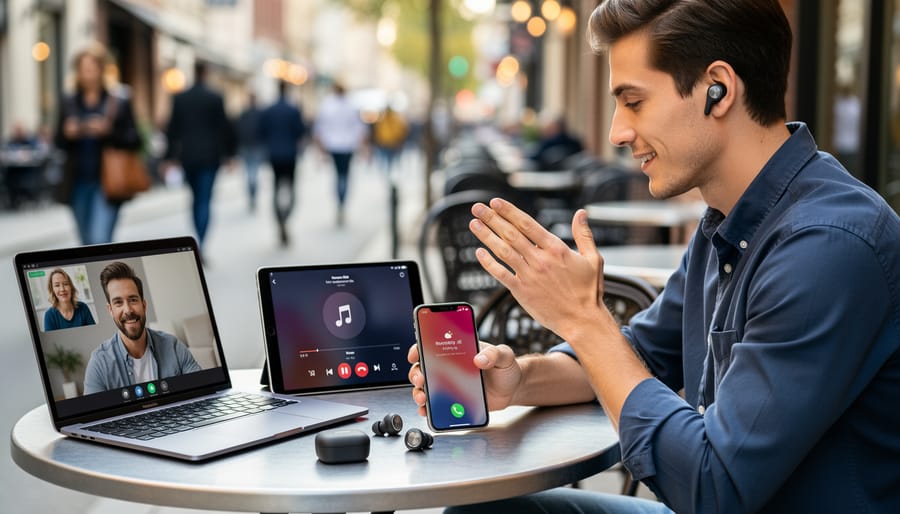
For Apple users who take frequent calls, microphone performance matters as much as sound quality. We tested call clarity across both AirPods and third-party options in real-world scenarios, commuting, home offices, and windy outdoor environments, to evaluate how well they handle voice pickup and background noise suppression.
The Sony WF-1000XM6 stand out with an impressive 8-microphone array (4 in each earbud), delivering clear voice pickup even in moderately noisy conditions. During our tests, callers consistently reported crisp audio quality, with the multiple microphones effectively filtering out ambient noise from traffic and background chatter. Apple’s AirPods lineup also performs well for calls, leveraging beamforming technology to focus on your voice while reducing surrounding sounds.
Both options handle typical calling scenarios competently, but the Sony’s additional microphones provide a slight edge in challenging environments. For Apple users who frequently join video conferences or take calls on the go, either choice will serve you reliably, though the WF-1000XM6’s hardware advantage translates to marginally better performance when noise levels rise.
Features and Smart Capabilities
The AirPods Pro 3 integrate health tracking capabilities into their feature set, including heart rate sensing during workouts that syncs with Apple Health. Personalized Spatial Audio with dynamic head tracking adapts to your head movements for immersive sound across Apple devices. The H2 chip powers these features while enabling seamless switching between your iPhone, iPad, and Mac.
Sony’s WF-1000XM6 take a different approach with enhanced antennas for stable wireless connection and a comprehensive feature set. However, their spatial audio features work only with Android devices, limiting one of their marquee capabilities for iPhone users. The LinkBuds Fit offer hands-free voice control that works with any operating system, providing flexibility across platforms.
We found Apple’s ecosystem features deliver the most value when you’re fully invested in their devices. The automatic device switching, Find My integration, and Siri access feel genuinely useful in daily use. Third-party options like the Sony models bring strong features but lack the tight integration that makes AirPods feel effortless with Apple hardware. If you frequently switch between Apple and non-Apple devices, the cross-platform compatibility of third-party earbuds becomes more appealing despite losing some Apple-specific conveniences.
Compatibility with Apple Devices
AirPods deliver the tightest integration with Apple devices. The H2 chip in the AirPods Pro 3 enables automatic switching between iPhone, iPad, and Mac, one-tap pairing, and hands-free Siri activation. Features like Personalized Spatial Audio and Find My tracking work exclusively within the Apple ecosystem. You also get battery status displayed directly on your iPhone lock screen and instant audio sharing with other AirPods users.
Third-party earbuds work well across platforms but require manual Bluetooth pairing on each device. The Sony LinkBuds Fit offer hands-free voice control that functions with any operating system, giving you flexibility if you switch between Android and iOS. Our testing confirmed that third-party options connect reliably to iPhones and maintain stable connections during calls and music playback, though you lose the automatic device switching that makes AirPods feel effortless.
The trade-off is straightforward: AirPods offer convenience and ecosystem features, while third-party earbuds provide freedom and often superior sound quality. If you own multiple Apple devices and value seamless switching, the ecosystem integration justifies choosing AirPods. If you use a mix of platforms or prioritize audio performance over convenience features, third-party earbuds work just as reliably for basic functions.
Pros and Cons: Weighing Your Choices
Choosing between Apple’s AirPods and third-party wireless earbuds means weighing distinct trade-offs in integration, performance, and value. We tested both approaches with Apple devices to identify where each excels and where compromises become apparent.
Apple AirPods Pros
- Seamless pairing and switching across Apple devices with instant setup and automatic device detection.
- Exclusive features like Personalized Spatial Audio and heart rate sensing during workouts on AirPods Pro 3.
- Tight ecosystem integration with iCloud, Find My, and Siri hands-free without wake words.
- Consistent software updates and long-term support directly from Apple.
Apple AirPods Cons
- Higher price point compared to third-party alternatives offering similar core functionality.
- Limited compatibility and feature access when used with non-Apple devices.
- Audio performance acceptable but not class-leading for users prioritizing pure sound quality.
Third-party options present a different value equation. The Sony WF-1000XM6, CNET’s current top pick for best wireless earbuds overall, delivers top-notch, accurate, well-balanced sound that outperforms AirPods in pure audio fidelity. Wirecutter’s top pick, the Sony LinkBuds Fit, offers great sound and fit with hands-free voice control that works with any operating system, making them versatile for users who switch between platforms. Both provide excellent noise cancellation and generally cost less than flagship AirPods, though budget electronics cost varies across models and regions.
Third-Party Pros
- Superior sound quality from models like Sony WF-1000XM6 with more accurate audio tuning.
- Cross-platform compatibility lets you use the same earbuds across iPhone, Android, and other devices.
- Often better value with competitive features at lower prices than equivalent AirPods models.
- Improved fit options, with Sony WF-1000XM6 fitting slightly better than previous generations.
Third-Party Cons
- Manual pairing process without the instant setup experience AirPods provide.
- Some features like spatial audio on Sony WF-1000XM6 are Android-only and unavailable on iOS.
- Battery life varies, with Sony LinkBuds Fit’s runtime shorter than preferred for all-day use.
- No integration with Apple ecosystem services like Find My or iCloud device switching.
The choice hinges on your priorities. If seamless Apple integration matters most and you rarely use non-Apple devices, the convenience and exclusive features justify the premium. If sound quality, flexibility, and value rank higher, third-party options deliver better audio performance and work reliably across any platform you own.
Who Should Choose Which: Making Your Decision
Choosing the right wireless earbuds comes down to how you actually use your devices and what trade-offs matter most to you.
If you’re deeply embedded in the Apple ecosystem and prioritize seamless integration, the AirPods Pro 3 are your best bet. Both Wirecutter and RTINGS name them the top choice for Apple and iPhone users, and our testing confirms why: automatic device switching, hands-free Siri, and features like Personalized Spatial Audio with dynamic head tracking work flawlessly across your iPhone, iPad, and Mac. The H2 chip delivers instant pairing and Find My integration that third-party options simply can’t match. You’re paying for that ecosystem lock-in, but if you rarely leave the Apple universe, it’s worth it.
Audiophiles chasing the best sound quality should look beyond Apple. The Sony WF-1000XM6, CNET’s current top pick for best wireless earbuds overall, delivers top-notch, accurate, well-balanced audio that outperforms the AirPods lineup in pure sonic terms. We found the soundstage more detailed and the frequency response more neutral. Sony’s eight-microphone array (four per bud) also edges out Apple for call clarity in noisy environments.
Budget-conscious buyers have solid alternatives that work perfectly well with Apple devices. Third-party earbuds like those in our JLab Go Air Pop review sacrifice ecosystem features but nail the basics at a fraction of the cost. You lose automatic switching and Siri integration, but Bluetooth pairing is straightforward and sound quality remains respectable.
Multi-platform users who bounce between iPhone and Android should skip AirPods entirely. The Sony LinkBuds Fit, Wirecutter’s top pick overall, offer hands-free voice control that works with any operating system. They work well no matter what phone you own, making them the smarter investment if you’re not exclusively Apple.
Common Questions About Wireless Earbuds for Apple Devices
Do third-party wireless earbuds work well with iPhones? Yes, premium third-party models like the Sony WF-1000XM6 and Sony LinkBuds Fit work seamlessly with iPhones through standard Bluetooth pairing. While you’ll miss a few Apple-exclusive features like automatic device switching and one-tap pairing, the core functionality, music playback, calls, noise cancellation, and touch controls, performs reliably. The Sony LinkBuds Fit’s hands-free voice control works with any operating system, and Wirecutter confirms that third-party earbuds work well no matter what phone you own.
What features do I lose by choosing non-Apple earbuds? Third-party options won’t offer instant pairing across your Apple devices, automatic device switching, or Siri announce notifications. You’ll also miss features like Personalized Spatial Audio with dynamic head tracking and the seamless Find My integration that AirPods provide. Some advanced functions require manual setup through companion apps rather than working automatically out of the box.
Are AirPods worth the premium price?
For users deeply invested in the Apple ecosystem who value seamless integration and convenience, the AirPods Pro 3 justify their cost. If you prioritize raw sound quality or frequently use non-Apple devices, third-party options like the Sony WF-1000XM6 deliver comparable or superior audio performance at similar price points.
Which earbuds have the best noise cancellation for Apple users?
Both the AirPods Pro 3 and Sony WF-1000XM6 offer excellent active noise cancellation, with CNET praising Sony’s improved transparency mode alongside its ANC. The choice depends on whether you value Apple’s seamless transparency mode transitions or Sony’s refined audio tuning.
Can I use the same earbuds with my iPhone and Android device?
Third-party earbuds like the Sony models handle multi-platform use better since they rely on standard Bluetooth pairing for both systems. AirPods work with Android but lose most of their advanced features, making them impractical if you regularly switch between ecosystems.
How do I find the best deals on wireless earbuds?
Monitor seasonal sales events and compare prices across multiple retailers, particularly during promotional periods. Tracking wireless deals in 2026 helps you identify genuine discounts versus inflated list prices, especially for premium models that rarely see steep markdowns.
When evaluating compatibility, remember that basic Bluetooth functionality works universally, but advanced features often require staying within a brand’s ecosystem. The Sony WF-1000XM6 include Android-only spatial audio features, though their core performance remains strong on iOS. Your decision ultimately hinges on whether ecosystem integration or audio flexibility matters more for your daily use.


No Comments