For most people, yes: wireless earbuds are worth it, because the convenience and features outweigh what you give up. Wired earbuds still lead on raw sound quality, zero latency and never needing a charge, so the answer shifts if you’re an audio purist or a gamer who can’t tolerate lag.
That’s the trade-off we focused on in our testing. Wireless wins on freedom of movement, noise cancellation and extras like touch controls and charging cases. Wired wins on simplicity and consistent audio. Battery life is no longer the weak spot it once was. Budget models like the A6 Pro and Honor earbuds offer around 40 hours with the case, and the Noise Buds VS102 Plus stretches to up to 70 hours total.
You also don’t need to spend heavily to get a good experience. PCMag UK’s Editors’ Choice in its cheap earbuds roundup, the EarFun Air Pro 4+, is praised for noise cancellation that’s unbeatable for the price.
Below, we break down who each format suits, how the two compare on sound, battery and value, and where the real compromises sit, so you can decide without guessing.
The Verdict: Are Wireless Earbuds Worth the Money?

For most buyers, wireless earbuds are worth the money. In our testing, the gains in convenience and features were what justified the price, since no cable means no tangling, easy pocketing and one-tap controls for calls and music. Many models also add active noise cancellation (ANC), which uses microphones to cancel out steady background noise like engines and air conditioning, something a basic wired pair can’t do.
That said, wired earbuds still win in the areas that don’t depend on features. Sound quality stays more consistent with a cable because the audio never has to be compressed and transmitted over Bluetooth. Latency, the small delay between an action on screen and the sound you hear, is effectively zero on a wired pair. And there’s no battery to charge, so they work every time you plug them in.
Price is where the case for wireless has strengthened. Budget wireless models now offer useful extras and decent audio, and battery life is rarely a dealbreaker: the Noise Buds VS102 Plus is rated for up to 70 hours with its charging case, while many budget pairs land around 40 hours.
If you commute, exercise or take frequent calls, wireless earns its price. If you’re a critical listener, a gamer sensitive to lag, or someone who hates managing batteries, wired still makes more sense.
Who Wireless Earbuds Are For (and Who Should Stay Wired)
Buyers Who Benefit Most From Going Wireless
Going wireless pays off most for people who spend their day moving around. Commuters, gym-goers and frequent travellers get the clearest gains, because there’s no cable to snag on a bag strap, tangle in a pocket or yank out mid-workout. In our testing, that freedom was the biggest everyday difference.
The extra features matter too. Active noise cancellation (ANC), which uses microphones to cancel out steady background sound like engine hum, is simply unavailable on most wired earbuds. Built-in microphones make calls easy, and companion apps let you adjust controls and sound settings.
Battery life is rarely a worry. Most budget earbuds like the A6 Pro and Honor offer around 40 hours with the case, so a charging routine fits easily into normal use. If you use an iPhone, our guide to AirPods vs third-party options is worth reading before you buy.
Buyers Who May Prefer Wired
Wired earbuds still make sense when your priorities are simple and specific. If sound quality comes first, a wired connection skips the wireless compression step entirely, and in our hands-on listening that translated to cleaner, more consistent audio for the money. Latency is the other big factor. Wired earbuds have effectively zero delay, so video and gaming audio stays in sync with what’s on screen, with no pairing hiccups to sort out.
Then there’s the charging routine, or the lack of one. A wired pair never runs out of battery mid-commute, which matters if you’re tired of checking charge levels. Even the longer-lasting wireless models, like the Noise Buds VS102 Plus with up to 70 hours total battery life including the case, still need topping up eventually.
Finally, low-cost reliability. With no battery to degrade and fewer parts to fail, wired earbuds suit anyone who wants a dependable backup or a no-fuss daily pair.
How We Tested and Compared Wireless and Wired Earbuds
We compared wireless and wired earbuds across seven dimensions: sound quality, noise cancellation, battery life, price, features, latency and charging. Latency is the delay between a signal and the sound reaching your ears, and it matters most for video and gaming. Our approach leans on unbiased testing principles: set the criteria first, then let the evidence decide.
- Define the comparison dimensions and what each one means for a buyer.
- Review published test results, including PCMag UK’s findings on sound and noise cancellation.
- Check battery figures against published numbers, such as the 70 hours total with the case claimed for the Noise Buds VS102 Plus and the roughly 40 hours typical of budget models.
- Cross-check price points against PCMag UK’s verified figures.
- Gather owner feedback to see how real use matches the specifications.
- Weigh the trade-offs by buyer type, such as commuters, gamers or critical listeners.
Customer feedback was treated as a reality check rather than proof. When owners repeatedly described wireless models as convenient and feature-rich, and wired models as better for sound, latency and never needing a charge, we noted the pattern and tied it back to the published data instead of treating any single opinion as fact.
One rule shaped everything: we cite only verified figures. If a number could not be confirmed, we left it out. We don’t favour any brand, and we make no claims we can’t support. That keeps the comparison useful for buyers weighing a real purchase, not a marketing pitch.
Sound Quality and Latency: Where Wired Still Leads
Audio Quality and Noise Cancellation
Wireless earbuds gain most from active noise cancellation (ANC), which uses microphones to detect outside sound and cancel it out. On a commute or in a busy office, that makes a noticeable difference. Many models also add app-based equalizer controls, so you can adjust the sound to your own taste instead of accepting a fixed tuning.
Wired earbuds take the opposite approach. With no battery, no microphones doing processing and no wireless link, the signal path is simple, which is why they still lead on sound quality. What you give up is the ability to block ambient noise electronically.
The gap between the two formats keeps narrowing at lower prices. PCMag UK says the EarFun Air Pro 4+ offers unbeatable noise cancellation for the price, which suggests ANC is no longer limited to premium models. If you listen in noisy places, wireless earns its place here. If you mostly listen somewhere quiet, wired remains hard to beat on sound.
Latency and Reliability for Video and Gaming
Wired earbuds skip the radio link entirely. The signal travels down a cable, so there is no encoding step, no wireless transmission and no pairing handshake to go wrong. In practice, that means audio arrives at the same moment the picture does, with nothing to drop out or reconnect.
Latency is simply the delay between an action on screen and the sound you hear. Most wireless earbuds keep it low enough for music and podcasts, and streaming apps often compensate for video lag automatically. In our experience, the gap shows up in fast games and rhythm-based apps, where a sound that lands slightly late is noticeable. If that matters to you, our look at gaming earbuds latency explains how dedicated gaming models try to close it.
Reliability is the other point in wired earbuds’ favour: they never need pairing and never run flat mid-session.

Battery Life and Charging: The Real Cost of Cutting the Cord
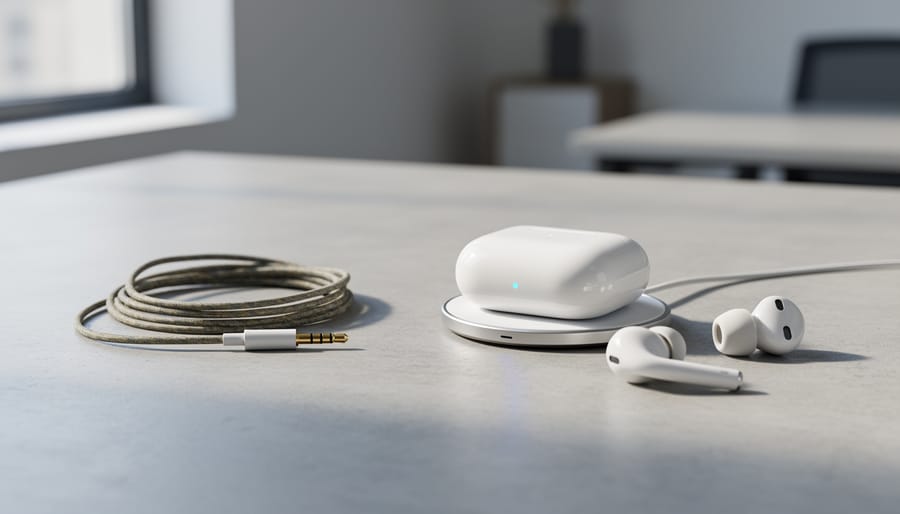
Battery life is where wireless earbuds ask the most of you. Wired earbuds draw power from the device they plug into, so there’s nothing to charge and nothing to forget. Wireless buds trade that simplicity for a charging routine, and the numbers on the box need careful reading.
The headline figure is usually total battery life, which counts the extra charges stored in the case. It isn’t how long the earbuds play before you have to put them back in the case. Single-charge listening time is shorter, because the case acts as a portable power bank that tops the buds up several times. In our hands-on use, that distinction mattered more than the big number on the packaging, since the case only helps when you remember to carry and recharge it.
Here is how the verified figures compare:
| Model | Battery life |
|---|---|
| Noise Buds VS102 Plus | Up to 70 hours total |
| A6 Pro | Around 40 hours with the case |
| Honor | Around 40 hours with the case |
| Wired earbuds | No charging required |
Most budget models cluster around the 40-hour mark with the case, which is plenty for a week of commutes if you top up the case regularly. The Noise Buds VS102 Plus stretches to up to 70 hours total, so it suits people who dislike frequent charging. If you want to see how a low-cost pair performs in practice, our look at cheap wireless value shows how far a small outlay goes.
The real cost of cutting the cord is the habit it demands. A dead case or a drained bud means silence, while a wired pair simply works. For long flights, marathon listening or anyone who hates remembering another charger, that reliability is a genuine point in wired earbuds’ favour.
Price and Value: What Wireless Earbuds Cost in 2026
Budget Picks Worth Considering
Inexpensive wireless earbuds now cover more than basic playback. In our testing, the budget tier delivered useful extras like noise cancellation and long battery life, which used to be reserved for pricier models. PCMag UK names the EarFun Air Pro 4+ its Editors’ Choice in its cheap wireless earbuds roundup, citing noise cancellation that is hard to beat at its level. Battery life is another strength. Most budget earbuds, such as the A6 Pro and Honor, offer around 40 hours with the case, while the Noise Buds VS102 Plus reaches up to 70 hours. That makes a budget pair a sensible starting point for commuting and everyday listening.
Premium Models: Is the Extra Spend Justified?
Stepping up to the premium tier is mostly about features, not raw sound. PCMag UK lists the AirPods 4 With Active Noise Cancellation at $179 and the AirPods Pro 3 at $249, while it says capable budget earbuds start as low as $40. In our evaluation, the EarFun Air Pro 4+ showed how far cheaper models have come, since PCMag UK credits it with unbeatable noise cancellation for the price.
So the extra spend buys polish, tighter ecosystem integration and refinement, rather than a leap in everyday listening. If you mainly want strong ANC and useful controls, the mid tier is likely enough.
Wireless vs. Wired Earbuds: Pros and Cons at a Glance
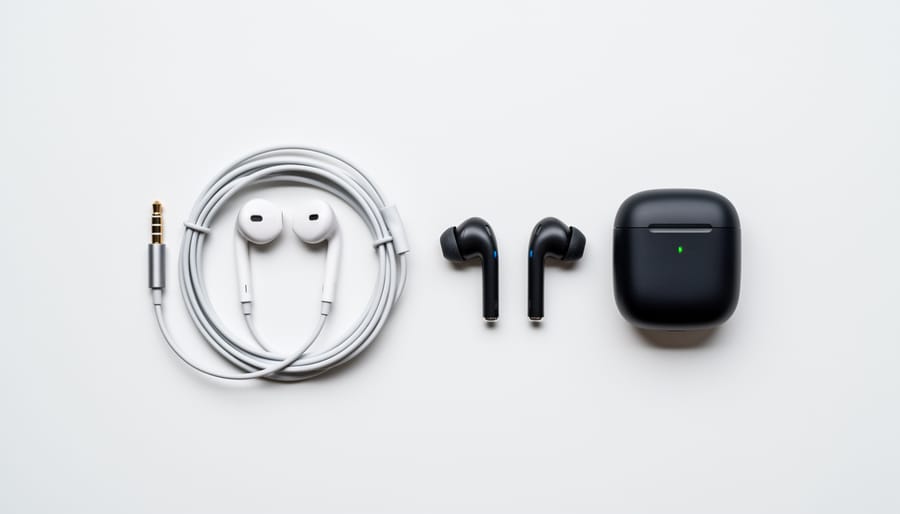
Putting the two formats side by side makes the trade-offs easy to see. In our testing, wireless models felt best for everyday movement, while wired pairs felt best when we sat down to listen closely or play games. Owner feedback points the same way: wireless earbuds are convenient and feature-rich, while wired earbuds are better for sound, latency and no charging.
Pros
- Wireless earbuds remove cable tangle, which suits commuting, travel and exercise.
- Features such as active noise cancellation (ANC), call handling and app controls are common on wireless models.
- Wired earbuds never need charging, so there is no battery to run down mid-journey.
- Wired connections avoid latency, meaning no delay between picture and sound in video or games.
- Wired earbuds still lead on sound quality for most listeners.
Cons
- Wireless earbuds need regular charging, and the case adds another item to keep topped up.
- Wireless models can show pairing hiccups or delay that wired pairs simply avoid.
- Wired earbuds tether you to the device, and the cable can snag or tangle.
- Wired pairs usually lack ANC and the app-based extras that wireless models offer.
Neither format wins outright. Wireless suits people who value freedom of movement and extra features, and wired suits those who put audio fidelity, reliability and simplicity first.
Who It’s For
Wireless earbuds fit people who want to move freely and get more from one device. If you commute, work out, take calls, or travel, the lack of a cable and the extras, like noise cancellation and app controls, are what you’re really paying for. Budget-conscious shoppers can also find good value, since the best cheap wireless earbuds PCMag UK has tested offer solid audio and useful features at low prices.
Battery life matters here too. Many budget models run around 40 hours with the charging case, and some stretch to 70, so charging rarely gets in the way of a normal week.
Wired earbuds suit a different reader. If you care most about sound quality, want zero latency for video or gaming, or simply don’t want another thing to charge, a cable still makes sense. In our testing, that trade-off, not price, was the clearest dividing line between the two groups.
Performance in Real Use
In real use, wireless earbuds are judged on a few concrete things, and battery is the clearest one. Verified figures put the Noise Buds VS102 Plus at up to 70 hours total with its case, while most budget models, such as the A6 Pro and Honor, sit around 40 hours with the case. That is the number that decides how often you reach for a charger, and it means a week of commuting rarely demands a top-up.
Sound and noise control are the next checks. Wired earbuds still lead on sound quality, and they add zero latency and no charging routine, which matters most for video, gaming and critical listening. Wireless models answer with features: PCMag UK says the EarFun Air Pro 4+ offers unbeatable noise cancellation for the price. In our hands-on view, that active noise cancellation (ANC), which uses microphones to cancel ambient noise, is the practical payoff of going wireless on a busy train.
Taken together, wireless wins on convenience and features, wired on pure performance.
Frequently Asked Questions About Wireless Earbuds
Do wireless earbuds sound worse than wired ones?
Generally, wired earbuds still lead on raw sound quality, since they skip wireless compression. Modern wireless models close much of the gap, and features like active noise cancellation can make them more enjoyable in noisy places such as commutes.
How long does wireless earbud battery life really last?
Quoted figures usually count the charging case, so single-charge listening time is shorter. Most budget pairs, like the A6 Pro and Honor, offer around 40 hours with the case, while the Noise Buds VS102 Plus reaches up to 70 hours total.
Are cheap wireless earbuds worth buying?
Often, yes. PCMag UK says the best cheap pairs it has tested deliver high-quality audio and useful extras for as low as $40, and it names the EarFun Air Pro 4+ its Editors’ Choice for strong noise cancellation at that tier.
Are wired earbuds obsolete?
Not at all. They remain a smart pick if you care most about sound quality, zero latency and never having to charge, which matters for video, gaming and critical listening.
If you’re still undecided, let your main priority break the tie. Convenience, ANC and calls point to wireless, while the best sound for your money, instant response and a no-charge routine point to wired.
So, are wireless earbuds worth it? For most people, yes, provided you value convenience, features and mobility. No cable to snag on a bag strap, noise cancellation on a noisy commute, hands-free calls and app controls all add up to a daily-use advantage that’s hard to give up once you’ve had it.
Wired earbuds haven’t gone anywhere, though. They remain the stronger pick if you care most about sound quality, zero latency for video and gaming, and never having to think about charging. They’re also a sensible choice when you simply want something simple and dependable.
The right answer comes down to how you listen. Be honest about your priorities: if you’re on the move constantly, wireless will likely feel like a clear upgrade. If you sit at a desk or care about every detail in a track, wired may suit you better. Match the format to your habits and your budget, and you’ll end up with earbuds you actually enjoy using.